


Page 101 - 《橡塑技术与装备》英文版2026年2期
P. 101
PRODUCT AND DESIGN
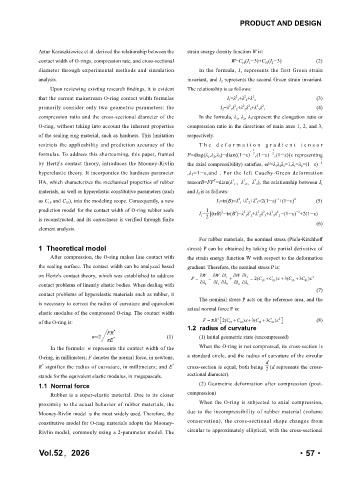
Artur Karaszkiewicz et al. derived the relationship between the strain energy density function W is:
contact width of O-rings, compression rate, and cross-sectional W=C 10 (I 1 -3)+C 01 (I 2 -3) (2)
diameter through experimental methods and simulation In the formula, I 1 represents the first Green strain
analysis. invariant, and I 2 represents the second Green strain invariant.
Upon reviewing existing research findings, it is evident The relationship is as follows:
2
2
2
that the current mainstream O-ring contact width formulas I 1 =λ 1 +λ 2 +λ 3 (3)
2
2
2
2
2
2
primarily consider only two geometric parameters: the I 2 =λ 1 λ 2 +λ 2 λ 3 +λ 3 λ 1 (4)
compression ratio and the cross-sectional diameter of the In the formula, λ 1 , λ 2 , λ 3 represent the elongation ratio or
O-ring, without taking into account the inherent properties compression ratio in the directions of main axes 1, 2, and 3,
of the sealing ring material, such as hardness. This limitation respectively.
restricts the applicability and prediction accuracy of the The deformation gradient tensor
1 1
-
-
formulas. To address this shortcoming, this paper, framed F=diag(λ 1 ,λ 2 ,λ 3 )=dian((1-ε) ,(1-ε) ,(1-ε)(ε representing
2
2
by Hertz's contact theory, introduces the Mooney-Rivlin the axial compressibility) satisfies, eF=λ 1 λ 2 λ 3 =1,λ 1 =λ 2 =(1-ε) - 1 2
hyperelastic theory. It incorporates the hardness parameter ,λ 3 =1-ε,and . For the left Cauchy-Green deformation
HA, which characterizes the mechanical properties of rubber tensorB=FF =dian(λ 1,λ 2,λ 3 ), the relationship between I 1
2
2
3
T
materials, as well as hyperelastic constitutive parameters (such and I 2 is as follows:
2
2
2
-1
as C 10 and C 01 ), into the modeling scope. Consequently, a new I 1 =tr(B)=λ 1 +λ 2 +λ 3 =2(1-ε) +(1-ε) 2 (5)
prediction model for the contact width of O-ring rubber seals 1
-2
2
2
2
2
I 1 = [(trB) -tr(B )=λ 1 λ 2 +λ 2 λ 3 +λ 3 λ 1 =(1-ε) +2(1-ε)
2
2
2
2
is reconstructed, and its correctness is verified through finite 2
(6)
element analysis.
For rubber materials, the nominal stress (Piola-Kirchhoff
1 Theoretical model stress) P can be obtained by taking the partial derivative of
After compression, the O-ring makes line contact with the strain energy function W with respect to the deformation
the sealing surface. The contact width can be analyzed based gradient. Therefore, the nominal stress P is:
on Hertz's contact theory, which was established to address P = ∂ W = ∂ W I ∂ 1 + ∂ W I ∂ 2 = 2(C + C )ε + 3(C + 3C )ε 2
contact problems of linearly elastic bodies. When dealing with ∂ λ 3 I ∂ 1 ∂ λ 3 I ∂ 2 ∂ λ 3 10 01 10 01
(7)
contact problems of hyperelastic materials such as rubber, it
The nominal stress P acts on the reference area, and the
is necessary to correct the radius of curvature and equivalent
elastic modulus of the compressed O-ring. The contact width actual normal force F is:
2
2
of the O-ring is: F = π R 2(C + C 01 )ε + 3(C + 3C 01 )ε (8)
10
10
1.2 radius of curvature
FR *
w=2 * (1) (1) Initial geometric state (uncompressed)
πE
In the formula: w represents the contact width of the When the O-ring is not compressed, its cross-section is
O-ring, in millimeters; F denotes the normal force, in newtons; a standard circle, and the radius of curvature of the circular
d
*
R signifies the radius of curvature, in millimeters; and E cross-section is equal, both being 2 (d represents the cross-
*
stands for the equivalent elastic modulus, in megapascals. sectional diameter).
1.1 Normal force (2) Geometric deformation after compression (post-
Rubber is a super-elastic material. Due to its closer compression)
proximity to the actual behavior of rubber materials, the When the O-ring is subjected to axial compression,
Mooney-Rivlin model is the most widely used. Therefore, the due to the incompressibility of rubber material (volume
constitutive model for O-ring materials adopts the Mooney- conservation), the cross-sectional shape changes from
Rivlin model, commonly using a 2-parameter model. The circular to approximately elliptical, with the cross-sectional
Vol.52,2026 ·57·

