


Page 58 - 《橡塑技术与装备》英文版2026年2期
P. 58
HINA R&P  TECHNOLOGY  AND EQUIPMENT


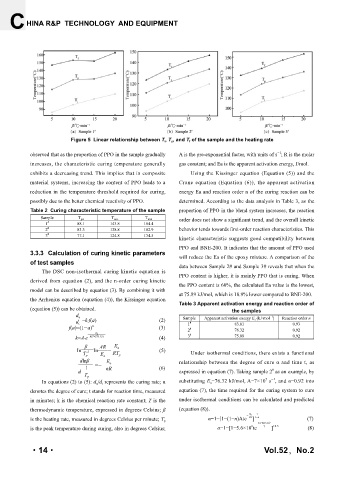
                         Figure 5  Linear relationship between T i , T p , and T f  of the sample and the heating rate

                                                                                               -1
           observed that as the proportion of PPO in the sample gradually   A is the pre-exponential factor, with units of s ; R is the molar
           increases, the characteristic curing temperature generally   gas constant; and Ea is the apparent activation energy, J/mol.
           exhibits a decreasing trend. This implies that in composite   Using the Kissinger equation (Equation (5)) and the
           material systems, increasing the content of PPO leads to a   Crane equation (Equation (6)), the apparent activation
           reduction in the temperature threshold required for curing,   energy Ea and reaction order n of the curing reaction can be
           possibly due to the better chemical reactivity of PPO.  determined. According to the data analysis in Table 3, as the
           Table 2  Curing characteristic temperature of the sample  proportion of PPO in the blend system increases, the reaction
               Sample      T gel       T cure     T treat    order does not show a significant trend, and the overall kinetic
                1 #        88.1       143.8       184.4
                2 #        83.3       138.8       182.9      behavior tends towards first-order reaction characteristics. This
                3 #        77.1       124.8       134.5
                                                             kinetic characteristic suggests good compatibility between
                                                             PPO and BNE-200. It indicates that the amount of PPO used
           3.3.3  Calculation of curing kinetic parameters   will reduce the Ea of the epoxy mixture. A comparison of the
           of test samples                                   data between Sample 2# and Sample 3# reveals that when the
               The DSC non-isothermal curing kinetic equation is
                                                             PPO content is higher, it is mainly PPO that is curing. When
           derived from equation (2), and the n-order curing kinetic   the PPO content is 60%, the calculated Ea value is the lowest,
           model can be described by equation (3). By combining it with
                                                             at 75.89 kJ/mol, which is 18.9% lower compared to BNE-200.
           the Arrhenius equation (equation (4)), the Kissinger equation
                                                             Table 3 Apparent activation energy and reaction order of
           (equation (5)) can be obtained.                                     the samples
                                                                                            -1
                                              d a  =k . f(a)                                               (2)  Sample  Apparent activation energy E a  (kJ·mol )  Reaction order n
                           d t                                  1 #             83.81               0.93
                                n
                                        f(a)=(1-a)                                                  (3)  2 #  76.32  0.92
                                 E a                             #
                                             k=A . e  R(T+273.15)                                          (4)                         3  75.89  0.92
                              β    AR   E a
                                              In  2 =In  -                              (5)        Under isothermal conditions, there exists a functional
                             T p   E a  RT p
                            dlnβ     E a                     relationship between the degree of cure α and time t, as
                                                 1  =-  nR                                   (6)
                                                                                             #
                           d                                 expressed in equation (7). Taking sample 2  as an example, by
                             T p
                                                                                             -1
                                                                                           7
               In equations (2) to (5): d α /d t  represents the curing rate; α   substituting E a =76.32 kJ/mol, A=7×10  s , and n=0.92 into
           denotes the degree of cure; t stands for reaction time, measured   equation (7), the time required for the curing system to cure
           in minutes; k is the chemical reaction rate constant; T is the   under isothermal conditions can be calculated and predicted
           thermodynamic temperature, expressed in degrees Celsius; β   (equation (8)).  1
                                                                                      ]                                     (7)
           is the heating rate, measured in degrees Celsius per minute; T p                 α=1−[1−(1−n)Ate -  E a RT 1-n
                                                                                        9.1797×10 3
                                                                                      6
           is the peak temperature during curing, also in degrees Celsius;                       α=1−[1−5.6×10 te  T  ] 12.5                       (8)

           ·14·                                                                           Vol.52,No.2

