


Page 56 - 《橡塑技术与装备》英文版2026年2期
P. 56
HINA R&P  TECHNOLOGY  AND EQUIPMENT


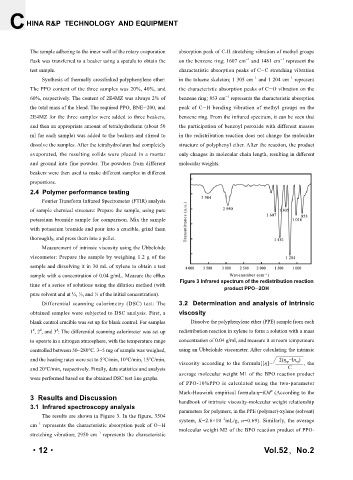
           The sample adhering to the inner wall of the rotary evaporation   absorption peak of C-H stretching vibration of methyl groups
                                                                                    -1
                                                                                                -1
           flask was transferred to a beaker using a spatula to obtain the   on the benzene ring; 1607 cm  and 1481 cm  represent the
           test sample.                                      characteristic absorption peaks of C=C stretching vibration
               Synthesis of thermally crosslinked polyphenylene ether:   in the toluene skeleton; 1 305 cm  and 1 204 cm  represent
                                                                                                  -1
                                                                                      -1
           The PPO content of the three samples was 20%, 40%, and   the characteristic absorption peaks of C-O vibration on the
                                                                             -1
           60%, respectively. The content of 2E4MZ was always 2% of   benzene ring; 853 cm  represents the characteristic absorption
           the total mass of the blend. The required PPO, BNE-200, and   peak of C-H bending vibration of methyl groups on the
           2E4MZ for the three samples were added to three beakers,   benzene ring. From the infrared spectrum, it can be seen that
           and then an appropriate amount of tetrahydrofuran (about 50   the participation of benzoyl peroxide with different masses
           ml for each sample) was added to the beakers and stirred to   in the redistribution reaction does not change the molecular
           dissolve the samples. After the tetrahydrofuran had completely   structure of polyphenyl ether. After the reaction, the product
           evaporated, the resulting solids were placed in a mortar   only changes its molecular chain length, resulting in different
           and ground into fine powder. The powders from different   molecular weights.
           beakers were then used to make different samples in different
           proportions.
           2.4  Polymer performance testing
               Fourier Transform Infrared Spectrometer (FTIR) analysis
           of sample chemical structure: Prepare the sample, using pure
           potassium bromide sample for comparison. Mix the sample
           with potassium bromide and pour into a crucible, grind them
           thoroughly, and press them into a pellet.
               Measurement of intrinsic viscosity using the Ubbelohde
           viscometer: Prepare the sample by weighing 1.2 g of the
           sample and dissolving it in 30 mL of xylene to obtain a test
           sample with a concentration of 0.04 g/mL. Measure the efflux
                                                              Figure 3 Infrared spectrum of the redistribution reaction
           time of a series of solutions using the dilution method (with
                                                                             product PPO-2OH
           pure solvent and at ½, ⅓, and ¼ of the initial concentration).
               Differential scanning calorimetry (DSC) test: The   3.2  Determination and analysis of intrinsic
           obtained samples were subjected to DSC analysis. First, a   viscosity
           blank control crucible was set up for blank control. For samples   Dissolve the polyphenylene ether (PPE) sample from each
               #
                    #
            #
           1 , 2 , and 3 : The differential scanning calorimeter was set up   redistribution reaction in xylene to form a solution with a mass
           to operate in a nitrogen atmosphere, with the temperature range   concentration of 0.04 g/ml, and measure it at room temperature
           controlled between 50~280℃. 3~5 mg of sample was weighed,   using an Ubbelohde viscometer. After calculating the intrinsic
           and the heating rates were set to 5℃/min, 10℃/min, 15℃/min,                         2(η sp −ln ηr )
                                                             viscosity according to the formula[[η]=   , the
           and 20℃/min, respectively. Finally, data statistics and analysis                       C
                                                             average molecular weight M1 of the BPO reaction product
           were performed based on the obtained DSC test line graphs.
                                                             of PPO-10%PPO is calculated using the two-parameter
                                                             Mark-Houwink empirical formula:η=ΚΜ  (According to the
                                                                                            α
           3  Results and Discussion                         handbook of intrinsic viscosity-molecular weight relationship
           3.1  Infrared spectroscopy analysis
                                                             parameters for polymers, in the PPE (polymer)-xylene (solvent)
               The results are shown in Figure 3. In the figure, 3504       -2
             -1
           cm  represents the characteristic absorption peak of O-H   system, K=2.6×10 mL/g, α=0.69). Similarly, the average
                                                             molecular weight M2 of the BPO reaction product of PPO-
           stretching vibration; 2950 cm  represents the characteristic
                                  -1
           ·12·                                                                           Vol.52,No.2

