


Page 57 - 《橡塑技术与装备》英文版2026年2期
P. 57
THEORY AND RESEARCH


              8%PPO is calculated as M 2 =6998, and the average molecular   Using the Origin plotting tool, the data obtained from the
              weight M 3  of the BPO reaction product of PPO-5%PPO is   DSC tester was plotted to generate the following DSC curves.
              calculated as M 3 =12,067.                        Figure 3 shows the DSC curves of three samples at heating
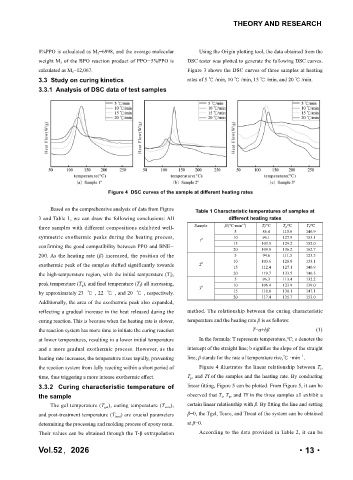
              3.3  Study on curing kinetics                     rates of 5 ℃ /min, 10 ℃ /min, 15 ℃ /min, and 20 ℃ /min.
              3.3.1  Analysis of DSC data of test samples


                                      Figure 4  DSC curves of the sample at different heating rates

                  Based on the comprehensive analysis of data from Figure   Table 1 Characteristic temperatures of samples at
              3 and Table 1, we can draw the following conclusions: All       different heating rates
                                                                                   -1
              three samples with different compositions exhibited well-  Sample  β/(℃·min )  T i /℃  T p /℃  T f /℃
                                                                                5         86.4  115.6   146.9
              symmetric exothermic peaks during the heating process,            10        96.1  127.9   153.1
                                                                    1 #
              confirming the good compatibility between PPO and BNE-            15       103.5  129.2   152.0
                                                                                20       109.8  136.2   162.7
              200. As the heating rate (β) increased, the position of the       5         94.6  111.5   123.5
                                                                                10       103.6  120.8   133.1
                                                                     #
              exothermic peak of the samples shifted significantly towards   2  15       112.4  127.1   140.9
              the high-temperature region, with the initial temperature (T i ),   20     119.7  133.5   146.3
                                                                                5         96.3  113.4   132.2
              peak temperature (T p ), and final temperature (T f ) all increasing,   10  106.4  123.9  139.0
                                                                    3 #
              by approximately 23 ℃ , 22 ℃ , and 20 ℃ , respectively.           15       110.8  130.1   147.1
                                                                                20       117.4  135.7   153.0
              Additionally, the area of the exothermic peak also expanded,
              reflecting a gradual increase in the heat released during the   method. The relationship between the curing characteristic
              curing reaction. This is because when the heating rate is slower,   temperature and the heating rate β is as follows:
              the reaction system has more time to initiate the curing reaction                                           T=a+bβ                                   (1)
              at lower temperatures, resulting in a lower initial temperature   In the formula: T represents temperature,℃; a denotes the
              and a more gradual exothermic process. However, as the   intercept of the straight line; b signifies the slope of the straight
                                                                                                      -1
              heating rate increases, the temperature rises rapidly, preventing   line; β stands for the rate of temperature rise,℃ ·min .
              the reaction system from fully reacting within a short period of   Figure 4 illustrates the linear relationship between T i ,
              time, thus triggering a more intense exothermic effect.  T p , and Tf of the samples and the heating rate. By conducting
              3.3.2  Curing characteristic temperature of       linear fitting, Figure 5 can be plotted. From Figure 5, it can be
              the sample                                        observed that T i , T p , and Tf in the three samples all exhibit a
                  The gel temperature (T gel ), curing temperature (T cure ),   certain linear relationship with β. By fitting the line and setting
              and post-treatment temperature (T treat ) are crucial parameters   β=0, the Tgel, Tcure, and Ttreat of the system can be obtained
              determining the processing and molding process of epoxy resin.   at β=0.
              Their values can be obtained through the T-β extrapolation   According to the data provided in Table 2, it can be

              Vol.52,2026                                                                            ·13·

