


Page 54 - 《橡塑技术与装备》英文版2026年2期
P. 54
HINA R&P  TECHNOLOGY  AND EQUIPMENT


                       Preparation of high-fluidity polyphenylene ether resin
                                      and study on its curing kinetics


                                       Xu Yunxiang, Li Yarui, Tang Yi, Wang Xuanlun*
            (College of Materials Science and Engineering, Chongqing University of Technology, Chongqing 400054, China)
               Abstract: This paper prepares low molecular weight polyphenylene ether through a redistribution reaction
           and analyzes the influence of the mass factor of the initiator benzoyl peroxide (BPO) in the reaction system
           on the molecular weight of the product polyphenylene ether. The molecular structure of the low molecular
           weight polyphenylene ether is characterized using infrared spectroscopy. The relative molecular mass of
           each product is measured and calculated using the viscosity method. Differential scanning calorimetry
           (DSC) is used to measure T i , T p , and T f  of the modified polyphenylene ether composite system, and then the
           activation energy E a , frequency factor A, and reaction order n are calculated through relevant equations.
           The curing reaction kinetics equation is derived from E a , A, and n. Finally, data analysis reveals that there is
           only one curing peak in the curing process of all samples, and the curing reaction is approximately a first-order
           reaction, indicating good compatibility between PPO and BNE-200.
               Key words: polyphenylene ether; redistribution reaction; low molecular weight; intrinsic viscosity; curing
           kinetics
               Classification number: TQ326.53                                     Article number: 1009-797X(2026)02-0010-06
               Document code: B                                                           DOI:10.13520/j.cnki.rpte.2026.02.002


           1 Introduction                                    normal production through pilot technology evaluation. It was
               Polyphenylene ether, whose full name is poly(2,6-  not until 2006 that BlueStar New Chemical Materials Co., Ltd.
           dimethyl-1,4-phenylene ether) and abbreviated as PPO, can   Ruicheng Branch successfully achieved mass production of
           also be referred to as polyphenylene oxide. Polyphenylene   polyphenylene ether with foreign technical support.
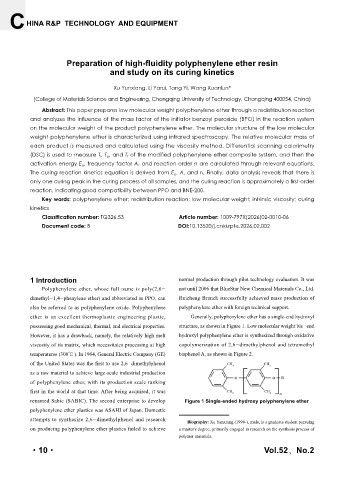
           ether is an excellent thermoplastic engineering plastic,   Generally, polyphenylene ether has a single-end hydroxyl
           possessing good mechanical, thermal, and electrical properties.   structure, as shown in Figure 1. Low molecular weight bis-end
           However, it has a drawback, namely, the relatively high melt   hydroxyl polyphenylene ether is synthesized through oxidative
           viscosity of its matrix, which necessitates processing at high   copolymerization of 2,6-dimethylphenol and tetramethyl
           temperatures (300℃). In 1964, General Electric Company (GE)   bisphenol A, as shown in Figure 2.
           of the United States was the first to use 2,6-dimethylphenol
           as a raw material to achieve large-scale industrial production
           of polyphenylene ether, with its production scale ranking
           first in the world at that time. After being acquired, it was
           renamed Sabic (SABIC). The second enterprise to develop   Figure 1 Single-ended hydroxy polyphenylene ether
           polyphenylene ether plastics was ASAHI of Japan. Domestic
           attempts to synthesize 2,6-dimethylphenol and research   Biography: Xu Yunxiang (1998-), male, is a graduate student pursuing
           on producing polyphenylene ether plastics failed to achieve   a master's degree, primarily engaged in research on the synthesis process of
                                                             polymer materials.

           ·10·                                                                           Vol.52,No.2

