


Page 77 - 《橡塑技术与装备》英文版2026年2期
P. 77
MATERIALS AND FORMULATIONS


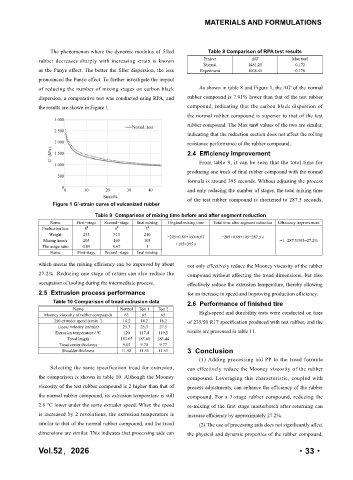
                  The phenomenon where the dynamic modulus of filled   Table 8 Comparison of RPA test results
              rubber decreases sharply with increasing strain is known   Project      ΔG'           Max tanθ
                                                                      Normal         1481.21         0.172
              as the Panye effect. The better the filler dispersion, the less   Experiment  1608.41  0.170
              pronounced the Panye effect. To further investigate the impact
              of reducing the number of mixing stages on carbon black   As shown in table 8 and Figure 1, the ΔG' of the normal
              dispersion, a comparative test was conducted using RPA, and   rubber compound is 7.91% lower than that of the test rubber
              the results are shown in Figure 1.                compound, indicating that the carbon black dispersion of
                                                                the normal rubber compound is superior to that of the test
                                                                rubber compound. The Max tanθ values of the two are similar,
                                                                indicating that the reduction section does not affect the rolling
                                                                resistance performance of the rubber compound.
                                                                2.4  Efficiency improvement
                                                                    From table 9, it can be seen that the total time for
                                                                producing one truck of final rubber compound with the normal
                                                                formula is around 395 seconds. Without adjusting the process
                                                                and only reducing the number of stages, the total mixing time
                                                                of the test rubber compound is shortened to 287.5 seconds,
                   Figure 1 G'-strain curve of vulcanized rubber
                                 Table 9  Comparison of mixing time before and after segment reduction
                  Name     First-stage  Second-stage  final mixing  Original mixing time  Total time after segment reduction  Efficiency improvement
               Production line  8 #     6 #       3 #
                  Weight     235       315        210    =205×0.89+160×0.67  =205×0.89+105=287.5 s
                Mixing time/s  205     160        105                                          =1-287.5/395=27.2%
               The usage ratio  0.89   0.67       1         +105=395 s
                  Name     First-stage  Second -stage  final mixing

              which means the mixing efficiency can be improved by about   not only effectively reduce the Mooney viscosity of the rubber
              27.2%. Reducing one stage of return can also reduce the   compound without affecting the tread dimensions, but also
              occupation of tooling during the intermediate process.  effectively reduce the extrusion temperature, thereby allowing
              2.5  Extrusion process performance                for an increase in speed and improving production efficiency.
                   Table 10 Comparison of tread extrusion data  2.6  Performance of finished tire
                          Name            Normal  Test 1  Test 2
                Mooney viscosity of rubber compounds  63  65  65    High-speed and durability tests were conducted on tires
                                  -1
                   250 extruder speed (r.min )  14.2  14.2  16.2  of 235/50 R17 specification produced with test rubber, and the
                    Linear velocity (m/min)  25.3  25.3  27.5
                    Extrusion temperature / ℃  120  117.4  119.5  results are presented in table 11.
                        Tread length      183.65  183.60  183.44
                     Tread center thickness  9.65  9.70  9.77
                      Shoulder thickness  11.58  11.55  11.63   3  Conclusion
                                                                    (1) Adding processing aid PP to the tread formula
                  Selecting the same specification tread for extrusion,   can effectively reduce the Mooney viscosity of the rubber
              the comparison is shown in table 10. Although the Mooney   compound. Leveraging this characteristic, coupled with
              viscosity of the test rubber compound is 2 higher than that of   process adjustments, can enhance the efficiency of the rubber
              the normal rubber compound, its extrusion temperature is still   compound. For a 3-stage rubber compound, reducing the
              2.6 ℃ lower under the same extruder speed. When the speed   re-mixing of the first stage masterbatch after returning can
              is increased by 2 revolutions, the extrusion temperature is   increase efficiency by approximately 27.2%.
              similar to that of the normal rubber compound, and the tread   (2) The use of processing aids does not significantly affect
              dimensions are similar. This indicates that processing aids can   the physical and dynamic properties of the rubber compound,


              Vol.52,2026                                                                            ·33·

