


Page 70 - 《橡塑技术与装备》英文版2026年2期
P. 70
HINA R&P  TECHNOLOGY  AND EQUIPMENT


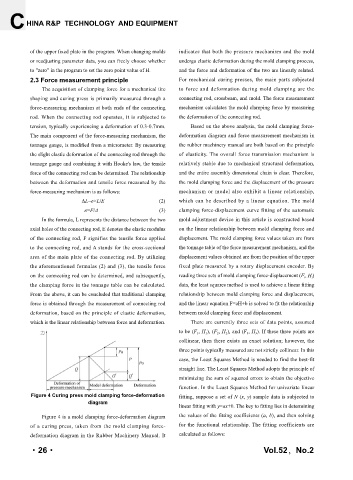
           of the upper fixed plate in the program. When changing molds   indicates that both the pressure mechanism and the mold
           or readjusting parameter data, you can freely choose whether   undergo elastic deformation during the mold clamping process,
           to "zero" in the program to set the zero point value of H.  and the force and deformation of the two are linearly related.
           2.3 Force measurement principle                   For mechanical curing presses, the main parts subjected
               The acquisition of clamping force for a mechanical tire   to force and deformation during mold clamping are the
           shaping and curing press is primarily measured through a   connecting rod, crossbeam, and mold. The force measurement
           force-measuring mechanism at both ends of the connecting   mechanism calculates the mold clamping force by measuring
           rod. When the connecting rod operates, it is subjected to   the deformation of the connecting rod.
           tension, typically experiencing a deformation of 0.3-0.7mm.   Based on the above analysis, the mold clamping force-
           The main component of the force-measuring mechanism, the   deformation diagram and force measurement mechanism in
           tonnage gauge, is modified from a micrometer. By measuring   the rubber machinery manual are both based on the principle
           the slight elastic deformation of the connecting rod through the   of elasticity. The overall force transmission mechanism is
           tonnage gauge and combining it with Hooke's law, the tensile   relatively stable due to mechanical structural deformation,
           force of the connecting rod can be determined. The relationship   and the entire assembly dimensional chain is clear. Therefore,
           between the deformation and tensile force measured by the   the mold clamping force and the displacement of the pressure
           force-measuring mechanism is as follows:          mechanism or model also exhibit a linear relationship,
                                             ΔL=σ×L/E                                         (2)  which can be described by a linear equation. The mold
                                               σ=F/A                                              (3)  clamping force-displacement curve fitting of the automatic
               In the formula, L represents the distance between the two   mold adjustment device in this article is constructed based
           axial holes of the connecting rod, E denotes the elastic modulus   on the linear relationship between mold clamping force and
           of the connecting rod, F signifies the tensile force applied   displacement. The mold clamping force values taken are from
           to the connecting rod, and A stands for the cross-sectional   the tonnage table of the force measurement mechanism, and the
           area of the main plate of the connecting rod. By utilizing   displacement values obtained are from the position of the upper
           the aforementioned formulas (2) and (3), the tensile force   fixed plate measured by a rotary displacement encoder. By
           on the connecting rod can be determined, and subsequently,   reading three sets of mold clamping force-displacement (F i , H i )
           the clamping force in the tonnage table can be calculated.   data, the least squares method is used to achieve a linear fitting
           From the above, it can be concluded that traditional clamping   relationship between mold clamping force and displacement,
           force is obtained through the measurement of connecting rod   and the linear equation F=aH+b is solved to fit the relationship
           deformation, based on the principle of elastic deformation,   between mold clamping force and displacement.
           which is the linear relationship between force and deformation.  There are currently three sets of data points, assumed
                                                             to be (F 1 , H 1 ), (F 2 , H 2 ), and (F 3 , H 3 ). If these three points are
                                                             collinear, then there exists an exact solution; however, the
                                                             three points typically measured are not strictly collinear. In this
                                                             case, the Least Squares Method is needed to find the best-fit
                                                             straight line. The Least Squares Method adopts the principle of
                                                             minimizing the sum of squared errors to obtain the objective
                                                             function. In the Least Squares Method for univariate linear
           Figure 4 Curing press mold clamping force-deformation   fitting, suppose a set of N (x, y) sample data is subjected to
                               diagram
                                                             linear fitting with y=ax+b. The key to fitting lies in determining
               Figure 4 is a mold clamping force-deformation diagram   the values of the fitting coefficients (a, b), and then solving
           of a curing press, taken from the mold clamping force-  for the functional relationship. The fitting coefficients are
           deformation diagram in the Rubber Machinery Manual. It   calculated as follows:

           ·26·                                                                           Vol.52,No.2

