


Page 69 - 《橡塑技术与装备》英文版2026年2期
P. 69
MACHINERY AND MOLD


              inside the upper fixed plate. Since the flange stud is fixed and   for measuring shaft-type rotations, and features a large
              assembled to the crossbeam panel with bolts, the motion is   measurement range, instantaneous position detection upon
              transmitted to the distance adjustment nut through the rotation   power-on, and no need for zero search.
              of the small gear, and ultimately fed back to the upper fixed   2.2  Mechanical displacement relationship
              plate. The mold connected to the upper fixed plate will achieve   In the retrofitting of the automatic mold adjustment
              a motion with twice the pitch of the trapezoidal teeth.  device, a rotary encoder is added to the mold adjustment
                                                                mechanism. This rotary encoder is installed on the web plate
                                                                of the crossbeam, and the rotary signal of the lower coupling
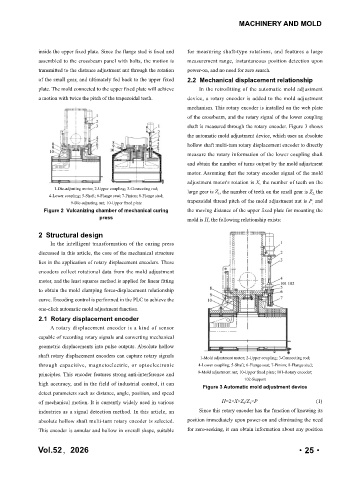
                                                                shaft is measured through the rotary encoder. Figure 3 shows
                                                                the automatic mold adjustment device, which uses an absolute
                                                                hollow shaft multi-turn rotary displacement encoder to directly
                                                                measure the rotary information of the lower coupling shaft
                                                                and obtain the number of turns output by the mold adjustment
                                                                motor. Assuming that the rotary encoder signal of the mold
                                                                adjustment motor's rotation is X, the number of teeth on the
                   1-Die-adjusting motor; 2-Upper coupling; 3-Connecting rod;   large gear is Z 1 , the number of teeth on the small gear is Z 2,  the
                  4-Lower coupling; 5-Shaft; 6-Flange seat; 7-Pinion; 8-Flange stud;
                         9-Die-adjusting nut; 10-Upper fixed plate  trapezoidal thread pitch of the mold adjustment nut is P ,  and
                Figure 2  Vulcanizing chamber of mechanical curing   the moving distance of the upper fixed plate for mounting the
                                   press                        mold is H, the following relationship exists:

              2  Structural design
                  In the intelligent transformation of the curing press
              discussed in this article, the core of the mechanical structure
              lies in the application of rotary displacement encoders. These
              encoders collect rotational data from the mold adjustment
              motor, and the least squares method is applied for linear fitting
              to obtain the mold clamping force-displacement relationship
              curve. Encoding control is performed in the PLC to achieve the
              one-click automatic mold adjustment function.
              2.1  Rotary displacement encoder
                  A rotary displacement encoder is a kind of sensor
              capable of recording rotary signals and converting mechanical
              geometric displacements into pulse outputs. Absolute hollow
              shaft rotary displacement encoders can capture rotary signals   1-Mold adjustment motor; 2-Upper coupling; 3-Connecting rod;
              through capacitive, magnetoelectric, or optoelectronic    4-Lower coupling; 5-Shaft; 6-Flange seat; 7-Pinion; 8-Flange stud;
              principles. This encoder features strong anti-interference and   9-Mold adjustment nut; 10-Upper fixed plate; 101-Rotary encoder;
                                                                                   102-Support
              high accuracy, and in the field of industrial control, it can
                                                                     Figure 3 Automatic mold adjustment device
              detect parameters such as distance, angle, position, and speed
              of mechanical motion. It is currently widely used in various                    H=2×X×Z 2 /Z 1 ×P                                            (1)
              industries as a signal detection method. In this article, an   Since this rotary encoder has the function of knowing its
              absolute hollow shaft multi-turn rotary encoder is selected.   position immediately upon power-on and eliminating the need
              This encoder is annular and hollow in overall shape, suitable   for zero-seeking, it can obtain information about any position

              Vol.52,2026                                                                            ·25·

